The U.S. government’s recent attempts to exclude TikTok and other Chinese tech companies from owning social media networks and apps set a dangerous precedent that challenges global democracy.
While the reasons may appear valid, the impact may undermine the notion of a free internet, writes Philip Mai at Ryerson’s Social Media Lab today in The Conversation Canada.
If the U.S. government is successful, and Chinese-owned tech companies may no longer operate in the country, the implication is that governments will be able to control the internet by establishing regulations around who can own platforms — and this has the potential to undermine how the internet has functioned so far.
As school boards across Ontario consider reopening in September, parents worry about two things: Will my children and I be safe, and will my children learn appropriately?
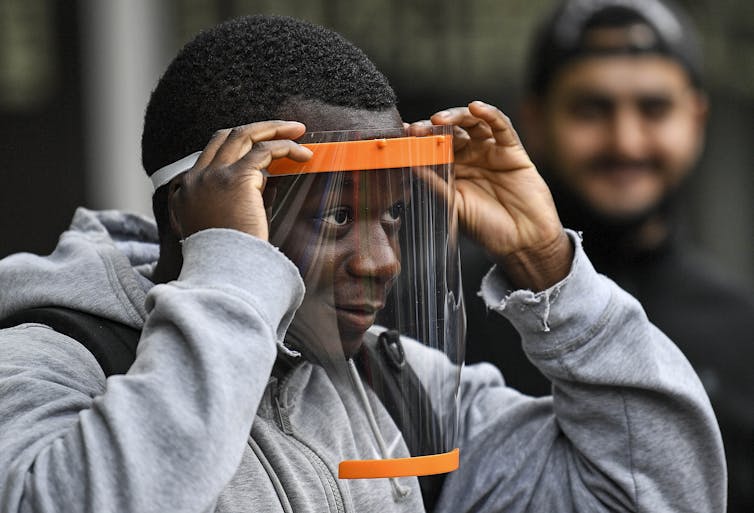
A student tries out a new face shield to fight the coronavirus pandemic at a school in Cologne, Germany, in May 2020. (AP Photo/Martin Meissner) (AP Photo/Martin Meissner)
The Ottawa School Board proposes to reopen its 72 schools five days a week in September. Dr. Vera Etches, Ottawa’s medical officer of health, supports the board. She recommended “starting with five days of school in-person and working to make this as safe as possible through reasonable and feasible infection prevention and control measures ….”
Unsafe premise
The error of Dr. Etches’ analysis begins with an unsafe premise — schools must reopen in September.
The first question should be whether schools can implement public health measures by September that will reduce risk of virus outbreaks to acceptable proportions. The answer to that question in many Ontario municipalities is no.
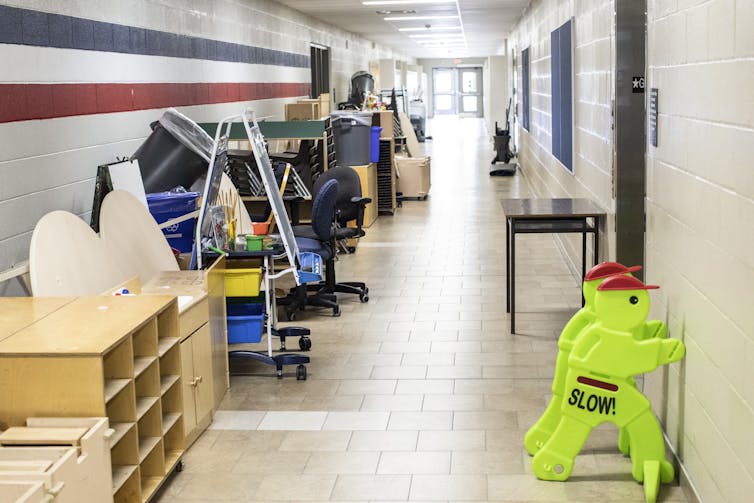
Furniture sits in an empty corridor at a school in Brampton, Ont., on July 23, 2020. THE CANADIAN PRESS/Chris Young
Other Ontario school boards are considering hybrid solutions — bringing back half their students on Mondays and Tuesdays, the other half on Thursdays and Fridays, and variations of this concept. This idea is unsafe.
Asymptomatic carriers among the returnees could transmit the virus to their classmates whether half, a third or a quarter of the student body attends.
Ontario boards failed woefully to educate students online from March through June. Since the proposal contains no measures to improve the education children will get online, the hybrid concept will simply continue this failure. It will also compromise face-to-face classrooms by deleting 60 per cent of instruction in them.
Reopen in January at the earliest
Ontario school boards should plan to reopen schools in January or September 2021. They should start now to renovate schools for safety protocols. Boards should work with the federal and provincial governments to develop resources to test each child for the virus every day.
Several companies and academic laboratories are developing easy-to-use diagnostic tests that could be used by schools, including a spit-test that looks for traces of SARS-CoV-2, the virus that causes COVID-19. Federal and provincial governments should organize, fund and fast-track getting this, and similar tests, into schools for January or September 2021.
Boards should invest heavily now in remote education. Remote learning is a relatively new science that arose out of a revolution in educational theory and produced distinctive educational practices. It is interactive, student-centred, digital — altogether different from reproducing existing classroom practices online, as occurred from March through June.
Six-year-old Peyton Denette works on her speech and language skills with speech-language pathologist Olivia Chiu of Two Can Talk remotely from her home in Mississauga, Ont., in March 2020. THE CANADIAN PRESS/Nathan Denette
Specialists to help teachers transform their courses into proper remote formats need to be hired, tech resources for universal and equal access must be purchased and people trained how to use them. Educators and staff should be trained in remote learning techniques.
Teachers, students need support
All of this will take time, leadership and investments. Teachers cannot become experts at remote education on their own. And students need help to adapt.
Children should return to school when the virus is sufficiently under control in their community and their school is made safe. Until then — which will not be this September — boards should concentrate on providing leadership and resources to make schools safe and enable superior remote learning.
The investments made now will pay back for years to come as elementary and secondary education is transformed.
We have in front of us a challenge and an opportunity, both of monumental importance. We have tens of thousands of great teachers waiting to rise to the challenge. Boards should empower them to seize the opportunity.
This year’s Top Operator report reflects the great uncertainty facing the oil and gas sector and tries to make sense of what the industry and successful operators in the post-pandemic future will look like.
To do so, we made some changes to the Top Operator format.
Rather than comparing year-over-year data, in some instances our CanOils analysts compared first quarter 2019/2020 data to measure the impact of the early stages of the COVID-19 pandemic.
We also tapped into the experience of professional services firm KPMG to gain insight into what strategies operators and service companies could pursue to survive and thrive through the difficult days ahead.
This is a 44 page report about how has survived the volatile market the last year and who has come out on top. Of course we aren’t done yet allows KPMG National Energy Leader
Michael McKerracher. He says, “Banks and lenders are coming down hard, especially on reserve-based loans, he explains. “We’ll see some recapitalizations as well as companies going into CCAA protection. We may see more of that because banks need to get leverage down.”
The outlook offered is positive if not cautious but the future is hard to predict at this point. Suncor suggests a close to normal return by 2022.
You’ll see who has the highest production and their strategies for success. The list of the top 25 include oilsands output (Q1 2019/ Q1 2020).
If you follow the link below, you can download the report in pdf format from the website.
Hopefully the federal government will be footing the bill. The UCP shut down most, if not all, energy efficiency projects last year. The only thing being funded in Alberta is coal and pipelines. Alberta is ramping up production in 2-3 coal mines to start. Tech Resources over in BC has six they’re mining. Going to have to change a lot of light bulbs to make up for increased toxic emissions.
The organization is calling for three immediate steps toward the 3% goals: training to help unemployed people enter the energy efficiency work force, provincial and municipal energy efficiency programs, and “strategic public investments to build a market for energy efficiency retrofit investments” through the Canada Infrastructure Bank and Canada Mortgage and Housing Corporation. In a sustainable recovery plan developed along with the International Monetary Fund, the IEA estimated that a $1-million investment in home energy retrofits creates nine to 30 jobs, Business in Vancouver says.
“A national retrofit program would also spread the spending across Canada, whereas many other greenhouse gas mitigation projects may only benefit a specific region,” the paper adds. And “once energy efficiency investments are made, they may result in lower utility costs to homeowners.”
“The government has just made it
harder for Canada to get on the right pathway to reach our target of
becoming net-neutral by 2050,” Julia Levin, climate and energy program
manager at Toronto-based Environmental Defence, said
in a release. “It is inconsistent to commit to a green recovery and
serious climate action while simultaneously failing to put in place a
mechanism to ensure that only projects that are consistent with those
goals are built.”
 The U.S. government’s recent attempts to exclude TikTok and other Chinese tech companies from owning social media networks and apps set a dangerous precedent that challenges global democracy.