The Quebec government may have nabbed some early headlines by tipping the centrepiece of its Green Economy Plan, a 2035 phaseout of internal combustion vehicle sales. But once the full strategy was released Monday, climate analysts and campaigners quickly concluded that it won’t meet the province’s greenhouse gas reduction targets.
Over the course of the five-year plan, most of the C$6.7 billion in the provincial announcement will be devoted to subsidizing electric vehicle purchases, CBC reports. But “climate change experts and environmental activists say that won’t be enough to put the province on track to meet its goal of reducing greenhouse gas emissions by 29 million tonnes of CO2 by 2030. They say more money should be invested in public transit and climate change mitigation.”
While the 29-megatonne reduction “remains Quebec’s stated goal, the plan only identifies a series of measures that will result in a reduction of 12.4 million tonnes of CO2 by 2030, according to the government’s own accounting,” the national broadcaster adds in a separate dispatch. “The 17.4-million-tonne difference will be achieved through unspecified technological advancements and a contribution from the federal government, also unspecified.”
“By itself the plan won’t be enough to address the challenges presented by the climate crisis,” Équiterre agreed.
As the hydrogen economy moves forward, countries are looking at applying hydrogen across three other categories: for heating, as a transportation fuel and for power generation. That will create new markets for hydrogen, as long as it can be produced in a low- or zero-emissions way.
Alberta has an opportunity to produce low cost blue hydrogen, initially for domestic application in its industrial processes and for blending with natural gas across power generation and heating applications.
By laying a foundation of technologically and economically viable hydrogen projects, Alberta would embed itself in the hydrogen economy at an early stage through key trade agreements and distribution channels. This will put in place a solid foundation that it can scale up as national and international hydrogen demand escalates through the 2020s and beyond.
It also would allow for a smart solution to decarbonizing hard to abate areas where electrification is not technically or economically feasible, they said. These strategic hydrogen deployments across mature applications that don’t require significant investment in distribution infrastructure and that help to reduce emissions across the Canadian energy and industrial sectors offer a stepwise approach to developing a Canadian hydrogen economy.
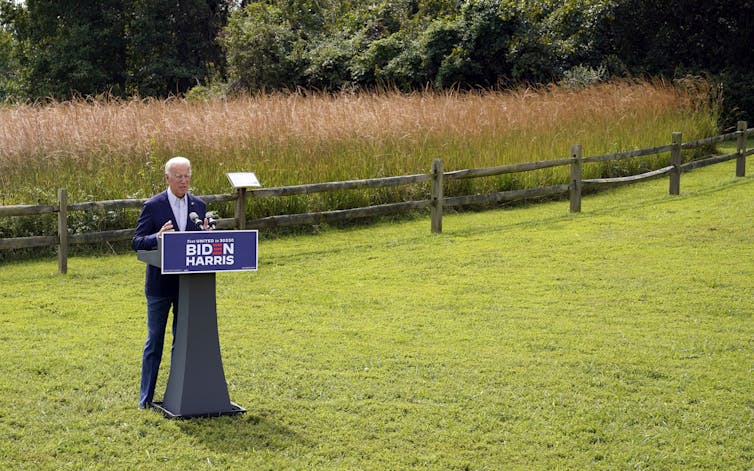
He also promised to eliminate federal subsidies to the oil industry and move to net-zero emissions by 2050. President Donald Trump, sensing a major blunder by his opponent, called on voters in Pennsylvania, Texas, Oklahoma and Ohio to vote against Biden’s energy plans.
The moment was noteworthy because it highlighted the new political importance of climate change and energy policy in U.S. politics. The Democratic candidate, now the president-elect, enthusiastically committed to taking action on climate change and energy transition. What’s equally significant is that Biden’s strong climate change position doesn’t appear to have hurt him in the key swing state of Pennsylvania or in the general election more broadly.
Serious climate plan
Although Biden’s climate plan is not as ambitious as the Green New Deal advocated by the left of the Democratic Party, his plans are serious.
He has called for a “Clean Energy Revolution” that includes mandatory emission cuts from electric utilities and support for electric vehicles. An interesting aspect of his overall plan is a commitment to spend at least 40 per cent of funds in historically disadvantaged areas.
Biden’s energy revolution will be limited by several factors, however.
His efforts will be constrained by the Democrats’ failure so far to win the Senate — two runoff elections in Georgia in early January will determine what party controls the chamber — combined with continued opposition from the fossil fuel industry and communities dependent upon fossil fuels.
Implications for Canada
Nevertheless, Biden can be expected to move ahead in response to climate science and pressure by some of his key constituencies, such as young people and progressives. This has significant implications for Canada and Canadians.
Any Canadians hoping for U.S. government support for the ongoing expansion of Canada’s fossil fuel infrastructure are likely going to be disappointed.
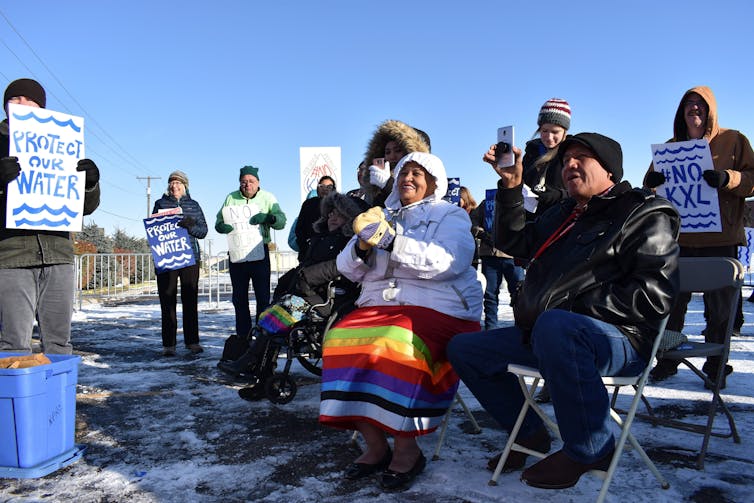
An example of this is the Keystone XL pipeline. Designed to bring Canadian oilsands bitumen to American refineries, its approvals were halted by former president Barack Obama in 2015 and renewed by Trump.
Opponents of the Keystone XL oil pipeline from Canada are seen demonstrating in sub-freezing temperatures on in October 2019 in Billings, Mont. (AP Photo/Matthew Brown)
Politically, this is a relatively painless action for Biden to burnish his climate change credentials. Canadian government and industry arguments about the need for more pipelines face an uphill battle.
More competition
A second implication is that Canadian industry can expect to see more competition from U.S. firms climbing on the climate change bandwagon. American companies will ramp up clean energy technologies and products. The question is whether Canadian-based industry will be up to the challenge and receive adequate government support.
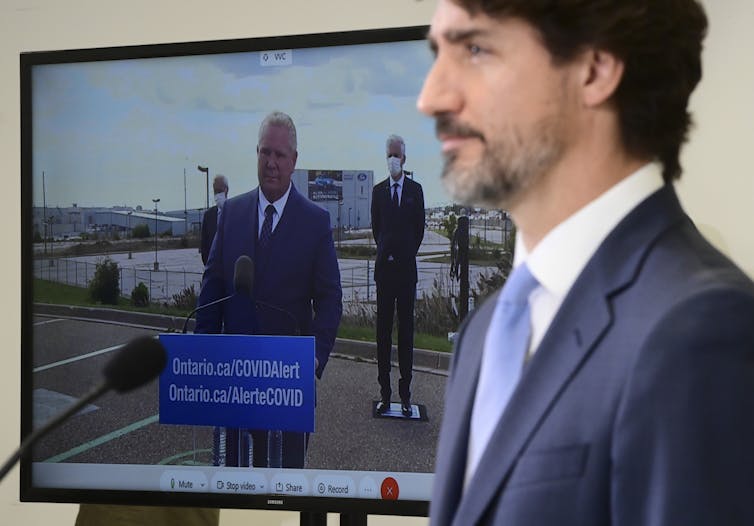
There is some indication that even some of the most anti-environmental politicians are slowly starting to recognize the urgency to take climate action. Ontario’s Premier Doug Ford has vigorously campaigned against any form of a carbon tax and rolled back measures supporting renewable energy.
Prime Minister Justin Trudeau takes part in a news conference at the Ford Connectivity and Innovation Centre in Ottawa in October 2020, joined virtually from Oakville by Ontario Premier Doug Ford. THE CANADIAN PRESS/Sean Kilpatrick
Yet he also recently committed $295 million to the Ford car company for its plans to build electric vehicles in Ontario.
This realization of the significant economic opportunities offered by green technologies opens up the door to a more evidence-based discussion of how public policy can support both a green economy and economic growth.
The transition is coming. The question is whether Canada will turn it into an opportunity to clean our air and environment, or make the transition more difficult by delaying action and spending vast sums to maintain fossil fuel production and employment.
The energy transition is a challenge facing all countries, but it will be particularly difficult for Canada because so much of our economy and large regions of our country are heavily dependent on the exploitation of fossil fuels.
Assistance for affected communities and industries is vital, but at the moment, many politicians are more comfortable denying the necessity and inevitability of the changes that are coming.
Indigenous communities that have been marginalized and harmed by other people’s exploitation of natural resources, as well as racialized and poor communities exposed to dangerous environmental risks, need to be integrated into clean energy spending.
People pause in a forested area along the Brunette River where trees are to be felled as part of Trans Mountain pipeline expansion, during a guided tour in Burnaby, B.C., in August 2020, led by Indigenous leaders and environmental groups. THE CANADIAN PRESS/Darryl Dyck
The president-elect is committed to moving on the issue of climate change. Important parts of his electoral coalition are also adamant that he oversee a transition to renewable energy. Equally important, his policies reflect the overwhelming scientific evidence that aggressive action to reduce greenhouse gas emissions is required to avoid serious economic and social consequences.
Can Canada respond similarly?
There is a discussion forum topic with a similar theme that’s titled, “How the U.S. election outcome could affect Canada’s environment and energy future” if anyone wants to discuss this topic.
“Joe Biden will take office with something no U.S. president has had before: robust popular support for climate action, borne out in polling data and election results from a hard-fought campaign,” reports Bloomberg Green. “Global warming was on the ballot to a surprising degree,” and “exit polls appear to show that his messages on climate broke through with voters,” with 74% declaring climate change “very important” to their vote and 67% lining up in favour of increased renewable energy spending.
Click here for our Special Report on climate and the U.S. election.
All in all, “his mandate to go all in on climate change and clean energy could not be more clear,” said Ed Maibach, director of the George Mason University Center for Climate Change Communication.
“They’ve given us a clear mandate for actions on COVID, the economy, climate change, systematic racism,” Biden said Friday night.
Ottawa, Ont. – Environmental Defence is extremely disappointed that the federal government has allowed Alberta and Saskatchewan to move forward with weak methane regulations, rather than strengthening federal regulations and insisting that those provinces improve theirs to match. Finalizing these agreements represents a failure of conviction on climate change from the Canadian government, given that methane emission reductions are some of the cheapest climate solutions available in Canada.
The federal government’s own analysis shows that Canada will fall far short of Prime Minister Justin Trudeau’s commitment to reduce methane emissions, foregoing 5 to 7 million tonnes of avoided greenhouse gases by 2025. These agreements will be challenging to open up before their expiry at the end of 2024, significantly increasing the chances that Canada will miss the 2025 target.
This meek approach to reducing emissions of a potent greenhouse gas – one that could be almost entirely eliminated in the next decade – casts further doubt on Canada’s commitment to fighting climate change, even while Canadians face mounting climate impacts. The Canadian government needs to stop bending over backwards to the Big Oil lobby and oil-friendly provincial governments at the expense of public health and action on the climate emergency.
About ENVIRONMENTAL DEFENCE CANADA (environmentaldefence.ca): Environmental Defence is a leading Canadian advocacy organization that works with government, industry and individuals to defend clean water, a safe climate and healthy communities.
-30-
For more information or to arrange an interview, please contact:
 The Quebec government may have nabbed some early headlines by tipping the centrepiece of its Green Economy Plan, a 2035 phaseout of internal combustion vehicle sales. But once the full strategy was released Monday, climate analysts and campaigners quickly concluded that it won’t meet the province’s greenhouse gas reduction targets.