Stretching more than 5,550 kilometres from the Kara Sea off the north
coast of Russia to the Bering Strait, the Northern Sea Route has long
been known to be the shortest passage between Europe and Asia, but shipping potential was limited by the fact that the route became blocked by thick ice in winter.
But the recent experimental voyage of the Christophe de Margerie,
an LNG tanker that left Russia fully loaded in early January bound for
China, has proven its viability. The ship returned to its home port last
week, this time accompanied by the nuclear-powered 50 Let Pobedy icebreaker (no icebreaker was needed on the trip out).
The voyage was the second in the past 10 months for the tanker, which
made the identical trip in May, a month earlier into spring than
normal.
Federal government-owned Trans Mountain is asking the Canada Energy
Regulator to keep secret the identities of the companies that provide
insurance coverage for its pipeline system because of fears
environmental activists will target them.
In a submission dated Monday, the company that operates the Trans
Mountain pipeline and its expansion project says there is evidence that
“certain parties” are using filings in the regulator’s database to
identify insurers and pressure them to drop their policies for the
pipeline.
The filings come days after Indigenous youth in Vancouver blocked the
entrances of buildings housing insurance companies to demand they stop
insuring the pipeline, resulting in four arrests.
In the west, Alberta and Saskatchewan are great locations for
building low-cost wind and solar farms. Enhanced interprovincial
transmission would allow Alberta and Saskatchewan to build more variable
wind and solar, with the assurance that they could receive backup power
from B.C. and Manitoba when the wind isn’t blowing and the sun isn’t
shining.
When wind and solar are plentiful, the flow of low cost energy can
reverse to allow B.C. and Manitoba the opportunity to better manage
their hydro reservoir levels. Provinces can only benefit from trading
with each other if we have the infrastructure to make that trade
possible.
Why a net-zero future depends on the ocean’s ability to absorb carbon
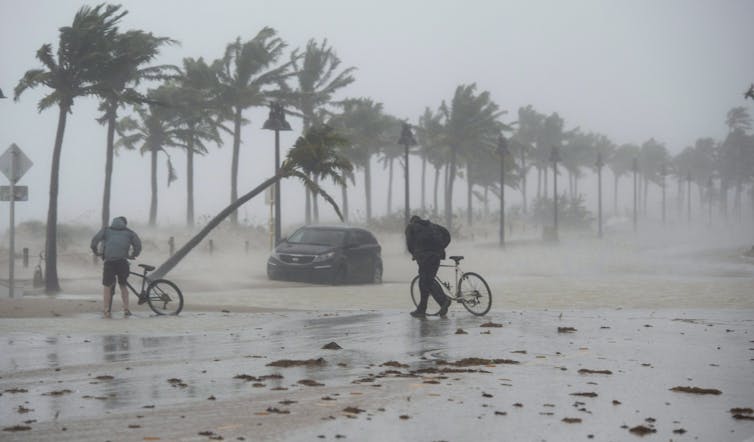
Two people walk their bicycles along a flooded street on the waterfront of Fort Lauderdale, Fla., as Hurricane Irma passes through on Sept. 10, 2017. THE CANADIAN PRESS/Paul Chiasson
Most of us growing up along Canada’s East Coast never worried about hurricane season. Except for those working at sea, we viewed hurricanes as extreme events in remote tropical regions, seen only through blurred footage of flailing palm trees on the six o’clock news.
Today, a warming ocean spins hurricanes faster, makes them wetter and drives them towards Atlantic Canada and even further inland. Hurricanes, winter storms and rising sea levels will continue to worsen unless we slow climate change.
The lifeblood of coastal economies and societies has always been the connection between land and sea, and that’s become more evident with climate change. But this isn’t just a coastal story anymore.
The oceans moderate the world’s climate through the absorption of heat and carbon. And just how much carbon the ocean will continue to absorb for us remains an open question. Whatever we do, it must be grounded in our growing wisdom of the deep connections between life on land and in the sea.
As Canada commits to a net-zero future and plans its post-COVID economic recovery, innovations and investments could backfire if they reduce the ocean’s ability to absorb our excesses.
Links between land and sea
The ocean has always directly affected the climate on land. The well-being of communities across the globe is directly linked to the ocean’s capacity to continue its regulating role of heat and carbon cycles.
Drought in the Prairies is tied to water temperatures in the Atlantic and Pacific oceans. When temperatures are most extreme, they signal the possible arrival of a “megadrought.”
In Australia, the occurrence of below-average rainfall, lasting several years, can be predicted by high Indian Ocean temperatures. This dries soils and lowers river flows, resulting in major community impacts such as water restrictions, declines in agricultural production and increased frequency of bushfires.
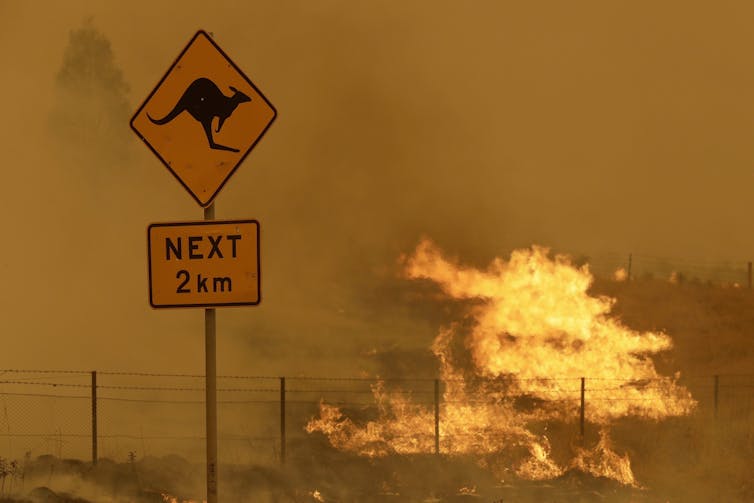
Fire burns in the grass near Bumbalong, south of the Australian capital, Canberra, on Feb. 1, 2020. (AP Photo/Rick Rycroft)
The success of Canada’s climate policies will therefore hinge on understanding how ocean processes are changing and society responds. The opportunity is at hand: Canada has committed to net-zero carbon in 2050, and to economic recovery once the COVID-19 pandemic has passed.
Prime Minister Justin Trudeau addresses the nation after the throne speech on Sept. 23, 2020.
The federal government’s throne speech in September highlighted the oceans as critical to economic recovery post-COVID. The “blue economy,” mentioned in the throne speech, includes fisheries, aquaculture and offshore wind energy.
These two commitments are fundamentally linked: economic recovery and carbon neutrality both depend on the ocean’s ability to continue to regulate climate through heat and carbon absorption.
But the development of national policies on climate change, both in Canada and internationally, has generally ignored the ocean in climate calculations. Scientists lobbied intensely before the Paris Climate Agreement just to make sure the ocean was mentioned.
Ocean carbon and heat absorption also provide a critical natural timescale against which we can measure our effectiveness in battling climate change. Fluctuations in the ocean “carbon sink” — the amount of carbon the ocean can remove from the atmosphere — will change the urgency with which we need to act.
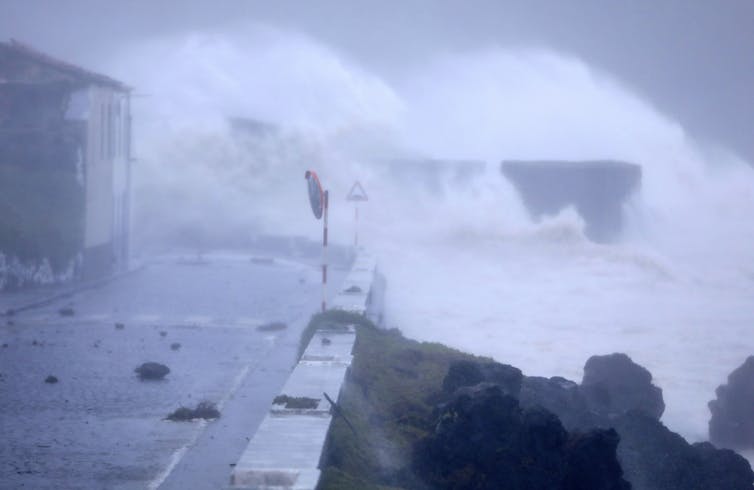
Hurricanes and winter storms will continue to worsen unless we slow climate change. Hurricane Lorenzo hit the Portuguese island of Faial in October 2019. (AP Photo/Joao Henriques)
For example, a waning carbon sink shrinks our window to curb land-based carbon emissions. But a growing sink might give us more time to enact difficult but necessary carbon policies that will have disruptive economic consequences.
There is no time for delay, and rewards come quickly; strong scientific evidence demonstrates that ocean processes controlling this absorption can either weaken or strengthen measurably in just a few decades.
Heat is absorbed physically from the atmosphere and mixed through the ocean on the scales of millennia. But carbon is absorbed through a complex network of chemical and biological processes, including coastal ecosystems such as kelp, mangroves and seagrasses that sustain local economies. Plankton (the tiny plants and animals that feed everything from mussels to whales) store carbon, so their behaviour and biology become a critical factor in the climate discussion.
We urgently need better observations of the ocean’s continued role as our heat and carbon sink.
Shifting carbon sink
The North Atlantic Ocean is the most intense carbon sink in the world: 30 per cent of the global ocean’s carbon dioxide removal occurs right in Canada’s backyard. If we extend Canada’s net-zero calculation to our exclusive economic zone (waters within 200 nautical miles of our coast), our net carbon emissions could change significantly.
Current estimates suggest including the oceans would reduce net emissions and help us get to net zero faster, but what happens if that changes? We must understand fully the processes controlling the “sink” to make the right climate policy choices.
This recalculation could shift our thinking on how to rejuvenate the Canadian economy. Investment in controversial industries such as deep-sea mining, which can supply materials needed for renewable ocean-based energy technologies like those used in offshore wind, can at the same threaten the very ocean ecosystems and food systems on which we depend. Formulating effective policies in the face of these uncertainties is a major challenge. Our path forward must build on our growing understanding of the deep connections between societal and ocean well-being.
Canadian researchers, including those at the Ocean Frontier Institute where we are based, are poised to address the fundamental questions about the ongoing role of the ocean in absorbing carbon, and to help develop appropriate policies. These conversations cut across traditional academic boundaries. In the past, ocean research was separated into the natural and applied, the social and human sciences. Now, we all need to work together.
The role of the ocean has been neglected for too long and must be drawn to the centre of the carbon discussion as we plot our trajectory to net-zero carbon in 2050. Canada’s carbon policies can lead the way internationally if they are grounded in strong, and strongly integrated, natural and social sciences. It is time for the research community to step up in their support.
The catastrophic cold snap that paralyzed the electrical grid in Texas has opened up a new front in the age-old battle between green-energy champions and their fossil-fuel rivals.
One side sees the chance to build a new, fortified and more sustainable power grid. The other calls it proof positive that it’s too soon to abandon oil, gas and coal.
We all agree that America deserves a cleaner future, but pursuing a path towards that future while ignoring energy reliability is the wrong approach.”
As soon as the Texas crisis began generating national headlines, conservative lawmakers and commentators seized their chance to sing the praises of fossil fuels.
It didn’t seem to matter that natural-gas production in Texas, which provides the bulk of the state’s power, was brought to a standstill by the cold. Frozen wind turbines and solar panels – together only worth 10 per cent of the state’s power supply – offered a powerful image.