I was in a bit of a shock when I read this headline this morning. The article says they want to have a number of terminals up and running by 2030. The plan is on having a strategy developed by strategy 2023. The announcement certainly outdoes the “going green news” rumoured out of Ontario.
The federal government has plans, too. They are well aware of what Alberta is planning. Their main concern will be whether Alberta stays under the emissions limit set for the province. It will be manufacturing blue hydrogen in contrast to green hydrogen. Blue relies on natural gas for it’s production whereas green doesn’t.
GM, Ford Toyota are planning on building more hydrogen and electric vehicles. It’s rumoured this could be another boom for Alberta which has a “new Alberta pipeline that would deliver natural gas for hydrogen-fuel applications along major trucking corridors “is a fantastic way to create jobs and position Canada well along the way to transition to zero-emission vehicles.”
There are already plans to use hydrogen for transport trucks and even the Canadian aerospace industry is eyeing a hydrogen-powered future with commercial aircraft concepts.
The cost of green hydrogen will drop 64 per-cent by 2040 so with a little more planning, green hydrogen manufacturing will be able to replace the blue and lower emissions considerably.
It’s certainly a step in the right direction. Maybe this will encourage the government to shut down new coal mine developments as well.
National Snow and Ice Data Centre director Mark Serreze points to melting ice in the arctic and increasing temperatures as being the direct result of climate change. It is the only thing that can be causing it. It’s also responsible for increased storms, droughts and wildfires across North America. The melting in Antarctica will certainly continue for the rest of this century. In fact, it may be irreversible.
We’ve already seen this has serious consequences for humanity and the various fish and animal species we share the planet with. This is why it’s so vital that we understand this is a climate crisis, and even more important for governments around the world to live up to their promises in the Paris Agreement.
The Liberal government has promised a growth plan that includes $2.5 billion for clean power and storage, $2 billion for building energy retrofits, $2 billion to extend broadband access to underserved communities, $1.5 billion for zero-emission buses, and $1.5 billion for agriculture infrastructure. This isn’t nearly enough, but it’s a step in the right direction if it happens. In April, it was announced, “Canada has signed on to a G20 energy communiqué led by Saudi Arabia that endorses fossil industry bailouts, contains not a single use of the word “climate”, makes no reference to the G20’s now 11-year-old promise to phase out “inefficient” fossil fuel subsidies, and endorses the host country’s perverse definition of a “circular carbon economy” that is long on unproven carbon capture technologies and short on meaningful commitments to actual decarbonization.
“Carbon is not the enemy,” insisted Saudi energy minister Prince Abdulaziz bin Salman when he introduced the circular carbon strategy earlier this year.”
In other words, they are going to use unproven strategies to try and limit emissions, but in the end, they’re still pumping out the oil that is destroying the world. The 11-year-old promise to phase out “inefficient” fossil fuel subsidies isn’t going to happen at all.
Minister for Natural Resources, Seamus O’Regan, released the following statement:
“G20 countries share an understanding that the security and economic prosperity of our people is tied to a well-functioning, stable energy market. That shared understanding was apparent in the discussions that took place today about multilateral solutions to oil price instability. We made a collective commitment to use all available tools to improve stability, as well as the creation of a short-term Focus Group, tasked with ensuring and reporting on coordinated response measures.
“Canada is the fourth-largest oil producer in the world. This sector of the economy powers more than 1,000 companies, which support over 3,500 businesses in the services sector and the jobs of more than 576,000 people, including 11,000 Indigenous people, in every part of Canada. The energy sector is also a critical component of Canada’s plan to achieve net-zero emissions by 2050.”
“Not a single climate plan released by a major oil company
comes close to aligning with the urgent 1.5°C global warming limit,”
Oil Change writes
in a release. “The discussion paper measures oil and gas company
climate plans against 10 minimum criteria for 1.5°C alignment,
underlining that commitments to stop expanding extraction and to
significantly decline production by 2030 are critical near-term tests.
It finds that each of the eight major companies assessed are failing,
scoring grossly insufficient or insufficient in a majority of criteria.”
The Supreme Court of Canada begins hearing appeals in three cases on Sept. 22 to determine whether Ottawa’s national carbon price is constitutional. Appellate courts in Saskatchewan and Ontario had previously upheld the law, but the Alberta Court of Appeal had ruled that it was unconstitutional and intruded on provincial powers.
Contrary to what critics of the federal carbon-pricing legislation say, neither the provinces’ authority to act on climate change nor the balance of the Canadian federation is in jeopardy.
In 2018, Ottawa enacted the Greenhouse Gas Pollution Pricing Act to implement the Pan-Canadian Framework. The act operates as a backstop — a national safety net — with two parts. The first imposes a charge on a broad range of greenhouse gas emitting fuels. The second establishes an “output-based performance system” that requires industrial facilities to pay for the emissions that exceed an annual limit.
Crucially, the backstop only applies in provinces or territories that request it or that have failed to price emissions through a direct price or cap-and-trade system at the minimum benchmark level established by Ottawa. Additionally, the backstop is “revenue neutral,” meaning that any money collected by Ottawa is returned to the jurisdiction. Provinces and territories are otherwise free to regulate within their borders, allowing them to impose even stronger limits on emissions.
Challenging co-ordinated climate action
With this co-ordinated national approach in place, Canada appeared poised to meaningfully contribute to global climate action, with both levels of government acting co-operatively.
Soon after, however, Ontario and Alberta adopted what’s been dubbed the “Saskatchewan strategy” of challenging the act on jurisdictional grounds. Each province asked its respective Court of Appeal for an advisory opinion on whether Ottawa has the jurisdiction to regulate greenhouse gas emissions.
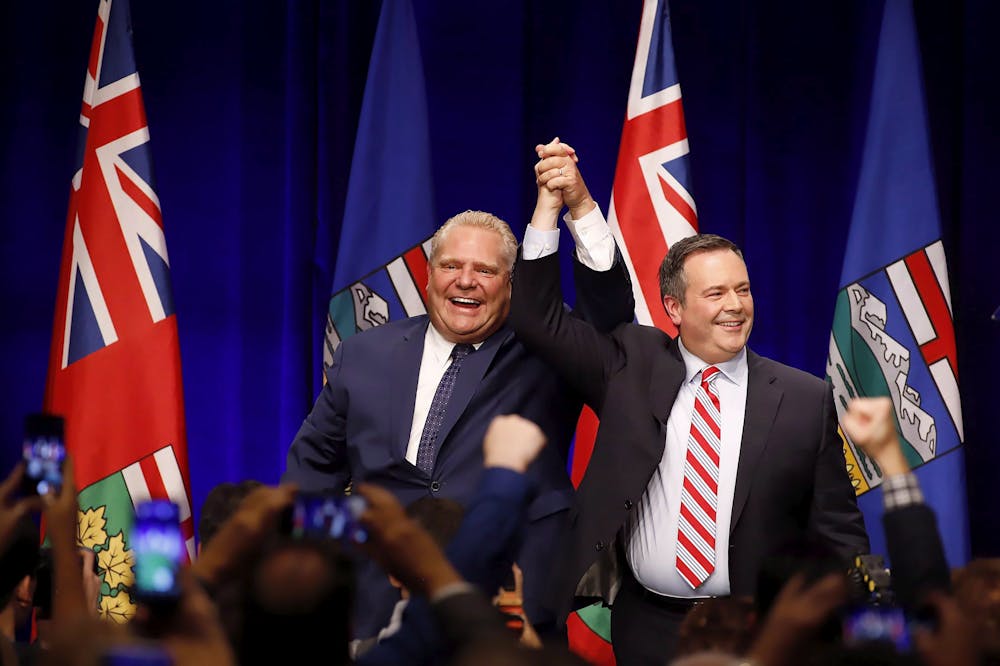
United Conservative Party Leader Jason Kenney and Ontario Premier Doug Ford cheer with supporters at an anti-carbon tax rally in Calgary, Oct. 5, 2018. THE CANADIAN PRESS/Jeff McIntosh
The thrust of these provinces’ constitutional challenges is that affirming Ottawa’s authority to regulate greenhouse gas emissions would intrude too deeply into provincial jurisdiction and jeopardize the balance of the Canadian federation.
But the “Saskatchewan strategy” of challenging Ottawa’s jurisdiction was as much about continuing a public policy dispute by other means. Climate policy, the provinces and their supporters argue, should be considered a local matter best left to local governments consistent with the constitutional principle of subsidiarity, the idea that public policy issues should be addressed at the most effective level of government closest to the citizens affected.
Neither argument is sound.
Canadian federalism is flexible and co-operative
Recognizing the federal government’s jurisdiction to regulate greenhouse gas emissions as a “national concern” won’t displace provincial climate regulations or alter the balance of federalism. The Supreme Court of Canada made this abundantly clear in R. vs. Crown Zellerbach Canada Ltd. more than 30 years ago.
That case concerned the federal government’s jurisdiction to regulate marine pollution, including dumping occurring entirely within the coastal waters of British Columbia. The court recognized federal jurisdiction to regulate marine pollution because it’s a transboundary issue reaching beyond both B.C.‘s and Canada’s borders.
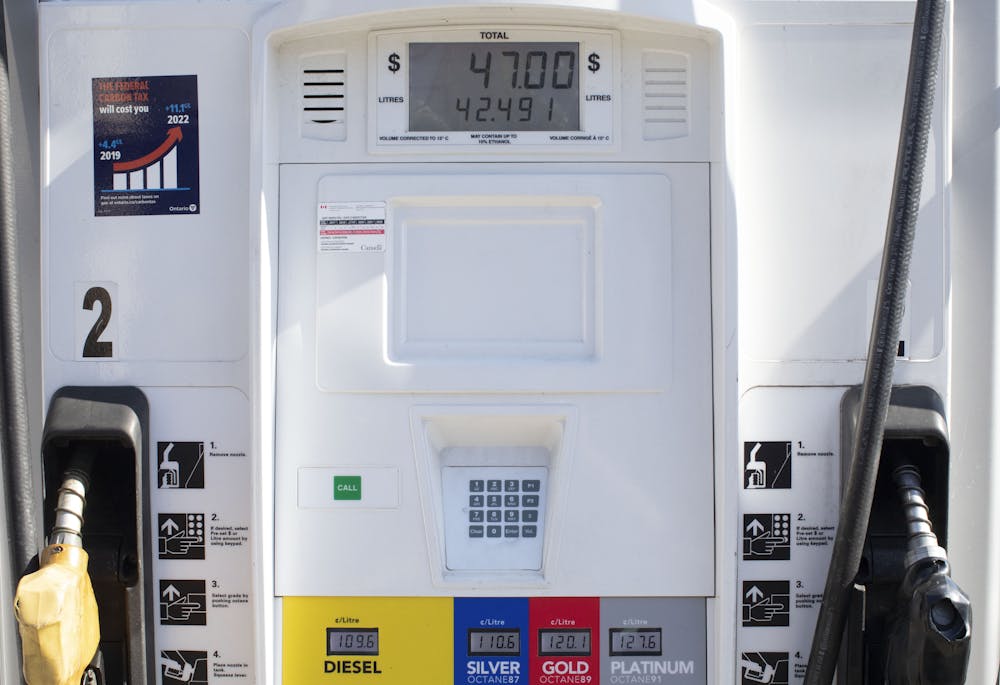
In 2019, Doug Ford’s Ontario government required gas stations to display a sticker at the pumps that said, ‘the federal carbon tax will cost you.’ The Ontario court has since said the stickers were unconstitutional. THE CANADIAN PRESS/Chris Young
This is how effective environmental regulation works in Canada. The City of Victoria, for instance, regulates sewage discharge into the ocean alongside federal law. Ottawa regulates toxic pollution federally under the Canadian Environmental Protection Act in conjunction with the provinces’ environmental pollution laws. Species at risk are protected in the same way: there’s a federal safety net to backstop provincial endangered species laws.
While the federal Greenhouse Gas Pollution Pricing Act isn’t sufficient to meet Canada’s initial — and notably unambitious — target under the Paris Agreement, to say nothing of Canada’s net-zero aspiration, this doesn’t strengthen the provinces’ argument for local regulatory authority. Instead, it further illustrates the urgent need for greater federal-provincial co-operation on climate action.
In each case, the contributing factors are different, but an underlying theme runs through the story: Hotter, drier seasons, driven by the burning of fossil fuels, have made the world more prone to erupt in flames.
“We don’t have a fire problem; we have many fire problems,” said Stephen J. Pyne, an emeritus professor at Arizona State University who studies wildfires and their history. “One, obviously, is a deep one. It has to do with fossil fuels and climate.”
Here’s a look at some of the worst recent blazes and how humans played a role in them.