Climate change, a supply of seals to eat and effective conservation in the United States are all possible explanations for the apparent increase in great white sharks in Atlantic Canada, according to a newly published paper in the Canadian Journal of Fisheries and Aquatic Sciences.
The peer-reviewed report, led by authors from the University of Windsor in Ontario, speculates on why more of the apex (top-of-the-food-chain) predators are being seen in the summer months, especially off Nova Scotia.
One hypothesis is that the great white shark’s range has shifted, bringing them into an area where they were rarely seen in the past.
Lightning strikes killed 147 people in the north Indian state of Bihar over the last 10 days, officials said Sunday, warning of more extreme weather conditions to come, driven by climate change.
Around 215 people — farmers, rural labourers and cattle graziers — have now died from strikes in the country’s poorest state since late March, authorities said.
“I was informed by weather experts, scientists and officials that rising temperatures due to climate change is the main cause behind the increasing lightning strikes,” Bihar’s Disaster Management Minister Lakshmeshwar Rai told AFP.
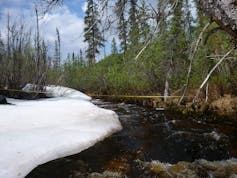
Through the long winter, many have endured cramped, icy quarters with perilously low oxygen levels. Others have recently journeyed incredible distances from large rivers and lakes to small summer habitats upstream.
Ice breaking up on a small northern stream. (Alyssa Murdoch)
But the survival tools these fish have used for millennia — exceptional tolerance to cold, slow growth rates and long lifespans — could be a disadvantage as environmental conditions in the north warm and more fast-paced species move in.
Our research team set out to see how stream fishes were responding to unprecedented environmental changes across their northern ranges. Ultimately, we wanted to know how these changes might affect the hundreds of thousands of people in Alaska and northern Canada that rely on local fisheries for food, culture and economic security.
A good news story?
On the surface, the results from our study appear to provide a “good news” story. Warming temperatures were linked to higher numbers of fish, more species overall and, therefore, potentially more fishing opportunities for northerners.
Initially, we were surprised to learn that warming was increasing the distribution of cold-adapted fish. We reasoned that modest amounts of warming could lead to benefits such as increased food and winter habitat availability without reaching stressful levels for many species.
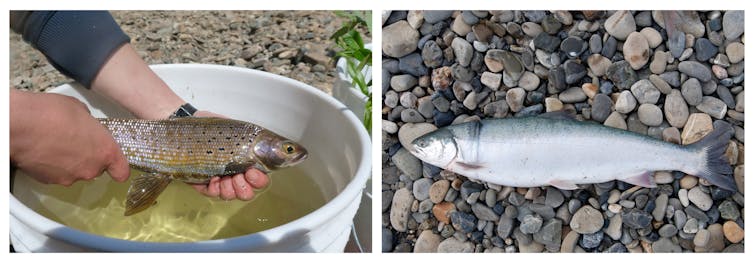
Photo of Arctic grayling (left) and Dolly Varden trout (right) (Alyssa Murdoch; Lilian Tran/Nunavik Research Centre and Tracey Loewen/Fisheries and Oceans Canada)
Yet, not all fish species fared equally well. Ecologically unique northern species — those that have evolved in colder, more nutrient-poor environments, such as Arctic grayling and Dolly Varden trout — were showing declines with warming.
Fish strandings and buried eggs
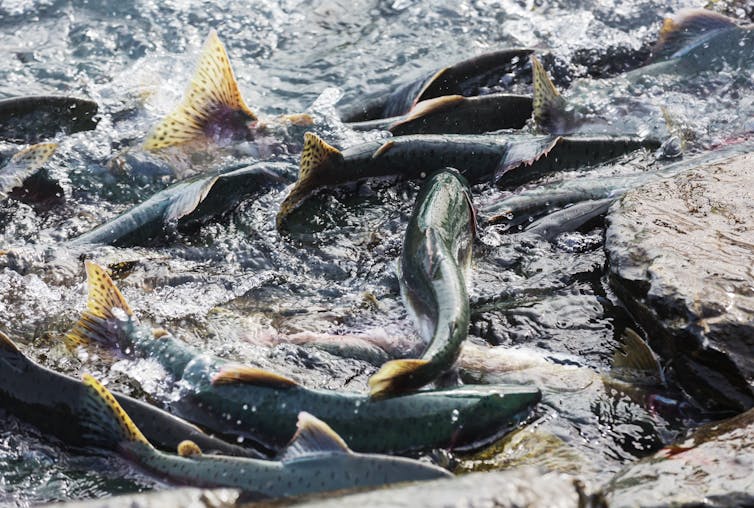
Recent news headlines run the gamut for Pacific salmon — from their increased escapades into the Arctic to massive pre-spawning die-offs in central Alaska. Similarly, results from our study revealed different outcomes for fish depending on local climatic conditions, including Pacific salmon.
We found that warmer spring and fall temperatures may be helping juvenile salmon by providing a longer and more plentiful growing season, and by supporting early egg development in northern regions that were previously too cold for survival.
In contrast, salmon declined in regions that were experiencing wetter fall conditions, pointing to an increased risk of flooding and sedimentation that could bury or dislodge incubating eggs.
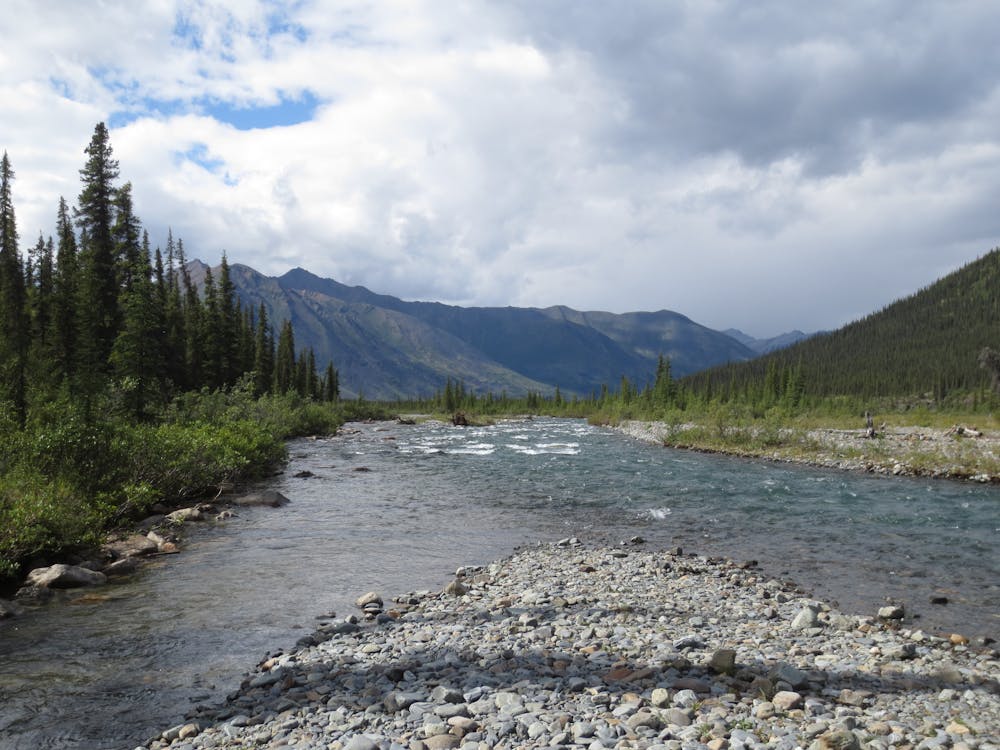
Headwaters of the Wind River within the largely intact Peel River watershed in northern Canada. (Don Reid/Wildlife Conservation Society Canada), Author provided
Interestingly, we found that certain climatic combinations, such as warmer summer water temperatures with decreased summer rainfall, were important in determining where Pacific salmon could survive. Summer warming in drier watersheds led to declines, suggesting that lowered streamflows may have increased the risk of fish becoming stranded in subpar habitats that were too warm and crowded.
The fate of northern fisheries
The promise of a warmer and more accessible Arctic has attracted mounting interest in new economic opportunities, including fisheries. As warming rates at higher latitudes are already two to three times global levels, it seems probable that northern biodiversity will experience dramatic shifts in the coming decades.
Although climate change action is urgently required at the global level, there are still tools that environmental managers can employ locally to reduce some of the effects. For example, watersheds with an elevated risk of flooding during the salmon incubation period could have more stringent streamside habitat protections, such as preserving larger areas of streamside vegetation from development, actively revegetating disturbed areas and conducting site-specific erosion and sediment control studies. In dangerously warm and dry years, fishing quotas could be reduced to limit salmon die-offs.
Ultimately, we advise that getting ahead of these impending changes by preserving the integrity of large intact watersheds will be key for protecting these evolutionary superstars from new human-driven pressures.
With medium-level human-caused climate change expected by the end of
the century, the world’s oceans, rivers and lakes will be too hot for
about 40% of the world’s fish species in the spawning or embryonic life
stages, according to a study in Thursday’s journal Science. That means they could go extinct or be forced to change how and where they live and reproduce.
Until now, biologists had just studied adult fish. For adult fish,
around 2% to 3% of the species would be in the too-hot zone in the year
2100 with similar projected warming. So using this new approach reveals a
previously unknown problem for the future of fish, scientists said.
Global warming will cause “catastrophic” biodiversity loss across the
world if greenhouse gas emissions aren’t curbed, with some ecosystems
liable to collapse as soon as 2030, according to new research into where
and when die-offs may occur.
Earth has never in human history warmed so quickly or uniformly as
currently, but a variety of factors affect temperatures in individual
regions, with significant seasonal and geographic variation.
Scientists predict that at the current level of manmade carbon
emissions, Earth is on course to heat up to four degrees Celsius by
2100.