A newly-released report
says it’s believed “the worst is yet to come” as Ontario’s food banks
recorded seeing an overall 26.5 per cent increase in first-time users
within the first four months of the COVID-19 pandemic.
The
same report found nearly half of food bank visitors said they’re
worried about getting evicted or defaulting on mortgage payments in the
coming months, while more than 93 per cent reported borrowing money,
accessing a payday loan or using credit to help pay for monthly
necessities.
Despite being characterized by the government as “binding”, the proposed law features a number of weaknesses and limitations. Further, while tabling this bill is a commendable step (especially if it becomes law), and is the result of many years of hard work and input from environmental organizations, it leaves difficult, long-standing conversations unaddressed.
Accountability and transparency mechanisms are then built around this milestone-targets-plans approach. The Minister would, under s 14(1), be required to prepare a “progress report” regarding each milestone year at least two years before the start of that year (i.e. the 2030 milestone year report would be due at the start of 2028). The progress report would have to contain an update on progress toward the target, an update on the specific information required in the plan (as per s 10(1) above), and “any other information… including information on any additional measures that could be taken to increase the probability of achieving the plans greenhouse gas emissions target” (s 14(2)).
Despite the government characterizing this proposed law as “binding”, that concept is distracting in this context. If passed, this act would certainly enshrine the 2050 net-zero target in legislation and create all the above-described target-setting, plan-making, and report-writing obligations. The current government would be obliged to comply with all this. However, the principle of parliamentary sovereignty, as reflected in section 42(1) of the federal Interpretation Act, RSC 1985, c I-21, dictates that parliaments of tomorrow have the power to repeal and amend any act of a previous parliament.
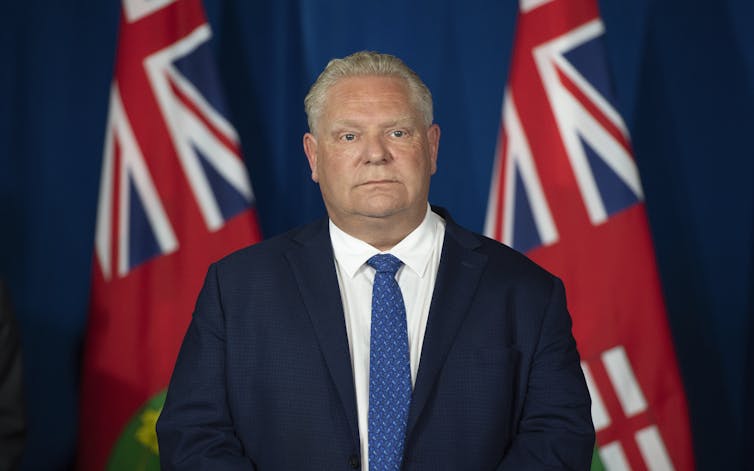
Ontario’s Progressive Conservative government has come to be defined by two things: its hesitant responses to the emerging second wave of COVID-19 and its relentlessly pro-business approach to virtually all other matters.
The situation invites the question of whether the government’s stumbling reluctance to impose more restrictive measures to head off the growing numbers of COVID-19 infections, as recommended by medical experts from across the province, is a product of its pro-business orientation.
On the COVID-19 front, recent days have been defined by some deeply disturbing trends: record daily rates of new infections; an already fatal reappearance of the virus in long-term care facilities; and projections of uncontrolled infection rates exceeding 6,500 cases per day, which will overwhelm hospital and intensive care unit capacity. Although the news of potentially effective vaccines is encouraging, their widespread availability seems many months off.
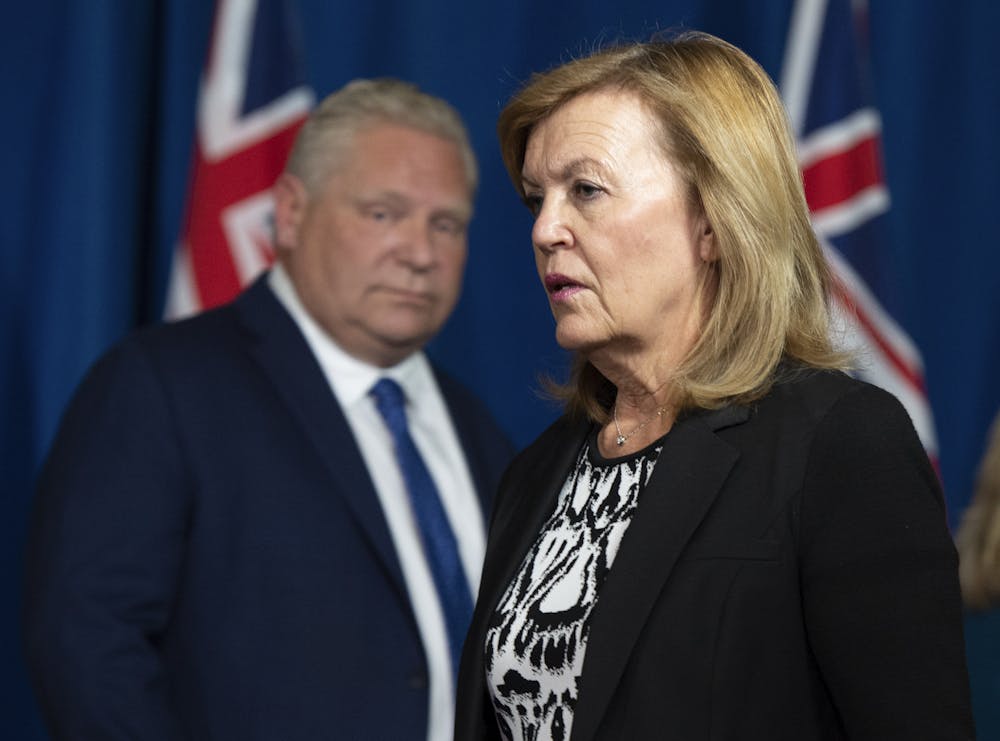
Ontario Premier Doug Ford watches as Health Minister Christine Elliott walks to the podium to answer questions at Queen’s Park on Nov. 16, 2020. THE CANADIAN PRESS/Frank Gunn
The provincial government’s responses to the situation have been surprisingly feeble. The province was actually moving in the direction of easing restrictions, particularly around public gathering spaces like restaurants, bars, gyms and places of worship, despite warnings that these could be key points of transmission.
It was then revealed that the province had ignored the advice of its own public health agency in terms of the infection rates needed to trigger further restrictions. The recommended thresholds for restrictions were reportedly increased by a factor of four relative to the advice received by the province from its own public health agency.
Taking the fall?
The imposition of further restrictions has been left in the hands of local medical officers of health despite the limited legal authority available to them. The province, it seemed, was prepared to let them take the political fall for the imposition of potentially unpopular restrictions.
The catastrophic projections released on Nov. 13 brought a partial turnaround by the province in terms of the thresholds for additional restrictions. But the government’s approach is still falling well short of what health authorities and experts are saying is needed to prevent disaster.
As if to add insult to injury, Ontario is poised to pass legislation that would effectively grant long-term care home owners and operators immunity from liability for the more than 1,800 resident deaths that occurred in their facilities during the first COVID-19 wave.
There is strong evidence that a significant portion of those fatalities were the result of neglect and poor care, rather than COVID-19 itself.
The province has extensive authority over public health matters, as well as a range of other legal and policy tools at its disposal to combat the virus. And on the surface, the government has consistently expressed concern and distress over the impacts of COVID-19 on its victims. Yet it had to be pushed into partial action by the recent outcry from the media and health experts over its failing responses.
Pro-business arguments
Why?
The answer may lie with Ford’s stance on issues beyond the pandemic. The essential feature of the Ford government has been its striking responsiveness to any argument presented to it from pro-business advocates and framed in terms of economic development.
The government’s record on the environment in this context is well-known: the shredding of Ontario’s climate change strategy; the elimination of the independent office of the environmental commissioner; the weakening or elimination of regulations on endangered species, forestry and toxic chemicals; and the evisceration of longstanding rules on industrial water pollution and environmental assessment.
Most striking of these tendencies has been the government’s willingness to acquiesce to the demands presented to it by the land development industry. Planning rules intended to curb urban sprawl in the Greater Toronto Area have been gutted.
The province has made unprecedented moves to reach deep into local municipal plans on behalf of development interests to eliminate constraints and permit ever greater development in areas like midtown Toronto that are already subject to intensive development pressures.
Ministerial zoning orders have been used with unprecedented frequency to override municipal and provincial rules on specific sites, most recently permitting a warehouse development in an environmentally significant wetland on Pickering’s Lake Ontario shoreline.
Provisions buried in the government’s November 2020 budget bill would undermine the role of local conservation authorities in controlling development for lands that are at risk of flooding and other hazards — significant considerations in the age of climate change — as well as for wetlands and shorelines.
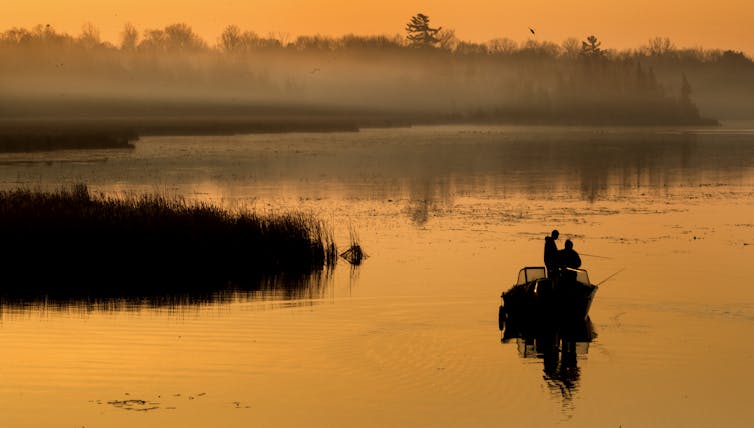
Early morning fishermen take advantage of warm weather on Pigeon Lake near Bobcaygeon, Ont., on Nov. 7, 2020. THE CANADIAN PRESS/Fred Thornhill
Sympathetic to business owners
The same unapologetic pro-business orientation seems to lie at the heart of the government’s response to the COVID-19 crisis.
The government has seemed particularly sympathetic to the pleas of small business owners, such as restaurants, bars and gyms, that would be affected by further shutdowns, despite the potentially significant roles these types of facilities could play in the spread of COVID-19.
A bartender and restaurant manager watch the news on television in the Port Credit neighbourhood of Mississauga, Ont., on Oct. 9, 2020. THE CANADIAN PRESS/Nathan Denette
That’s profoundly short-sighted, laying the groundwork for disastrous runaway outbreaks like those occurring in the United States. Those types of outbreaks may only be able to be controlled, if at all, through the types of draconian and long-term lockdowns seen in places like Melbourne, Australia. The impact would be far more damaging to businesses than additional short-term restrictions.
A more effective and balanced approach would recognize the need for far greater restrictions in the short term, while working with the federal government to provide support to affected employees and helping businesses move their operations to take-out, delivery, curbside pickup and online services wherever possible.
Events in the U.S. and Europe are demonstrating just how bad a second COVID-19 wave could be. If the Ford government acts decisively, it may still be able to avoid the same fate, but time is running out quickly.
Related
Ontario health care workers announce 22 political protests against the PC government’s removal of their basic workplace rights
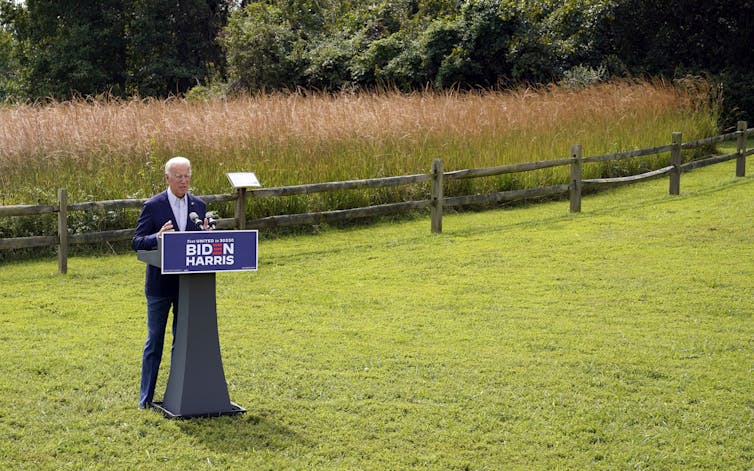
He also promised to eliminate federal subsidies to the oil industry and move to net-zero emissions by 2050. President Donald Trump, sensing a major blunder by his opponent, called on voters in Pennsylvania, Texas, Oklahoma and Ohio to vote against Biden’s energy plans.
The moment was noteworthy because it highlighted the new political importance of climate change and energy policy in U.S. politics. The Democratic candidate, now the president-elect, enthusiastically committed to taking action on climate change and energy transition. What’s equally significant is that Biden’s strong climate change position doesn’t appear to have hurt him in the key swing state of Pennsylvania or in the general election more broadly.
Serious climate plan
Although Biden’s climate plan is not as ambitious as the Green New Deal advocated by the left of the Democratic Party, his plans are serious.
He has called for a “Clean Energy Revolution” that includes mandatory emission cuts from electric utilities and support for electric vehicles. An interesting aspect of his overall plan is a commitment to spend at least 40 per cent of funds in historically disadvantaged areas.
Biden’s energy revolution will be limited by several factors, however.
His efforts will be constrained by the Democrats’ failure so far to win the Senate — two runoff elections in Georgia in early January will determine what party controls the chamber — combined with continued opposition from the fossil fuel industry and communities dependent upon fossil fuels.
Implications for Canada
Nevertheless, Biden can be expected to move ahead in response to climate science and pressure by some of his key constituencies, such as young people and progressives. This has significant implications for Canada and Canadians.
Any Canadians hoping for U.S. government support for the ongoing expansion of Canada’s fossil fuel infrastructure are likely going to be disappointed.
An example of this is the Keystone XL pipeline. Designed to bring Canadian oilsands bitumen to American refineries, its approvals were halted by former president Barack Obama in 2015 and renewed by Trump.
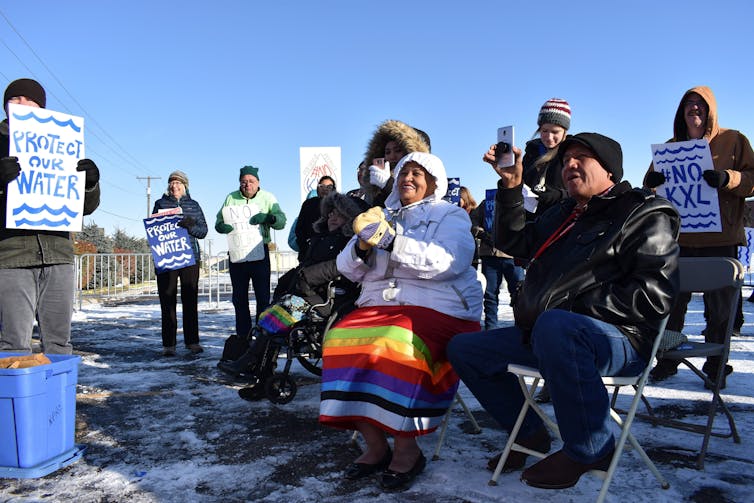
Opponents of the Keystone XL oil pipeline from Canada are seen demonstrating in sub-freezing temperatures on in October 2019 in Billings, Mont. (AP Photo/Matthew Brown)
Politically, this is a relatively painless action for Biden to burnish his climate change credentials. Canadian government and industry arguments about the need for more pipelines face an uphill battle.
More competition
A second implication is that Canadian industry can expect to see more competition from U.S. firms climbing on the climate change bandwagon. American companies will ramp up clean energy technologies and products. The question is whether Canadian-based industry will be up to the challenge and receive adequate government support.
There is some indication that even some of the most anti-environmental politicians are slowly starting to recognize the urgency to take climate action. Ontario’s Premier Doug Ford has vigorously campaigned against any form of a carbon tax and rolled back measures supporting renewable energy.
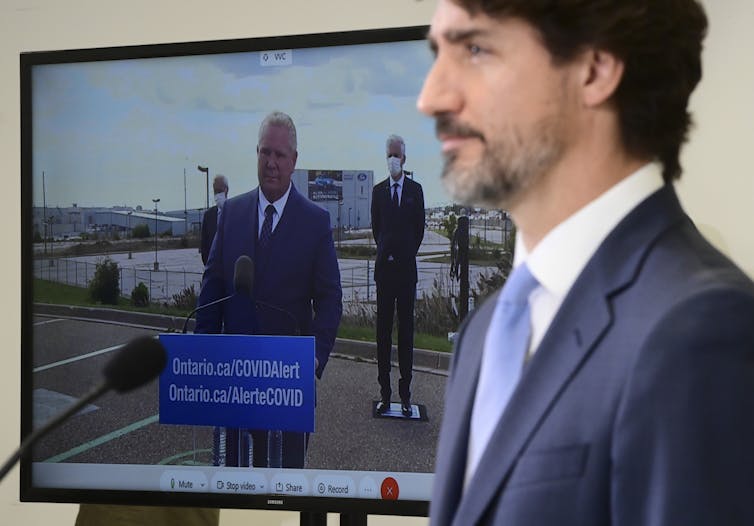
Prime Minister Justin Trudeau takes part in a news conference at the Ford Connectivity and Innovation Centre in Ottawa in October 2020, joined virtually from Oakville by Ontario Premier Doug Ford. THE CANADIAN PRESS/Sean Kilpatrick
Yet he also recently committed $295 million to the Ford car company for its plans to build electric vehicles in Ontario.
This realization of the significant economic opportunities offered by green technologies opens up the door to a more evidence-based discussion of how public policy can support both a green economy and economic growth.
The transition is coming. The question is whether Canada will turn it into an opportunity to clean our air and environment, or make the transition more difficult by delaying action and spending vast sums to maintain fossil fuel production and employment.
The energy transition is a challenge facing all countries, but it will be particularly difficult for Canada because so much of our economy and large regions of our country are heavily dependent on the exploitation of fossil fuels.
Assistance for affected communities and industries is vital, but at the moment, many politicians are more comfortable denying the necessity and inevitability of the changes that are coming.
Indigenous communities that have been marginalized and harmed by other people’s exploitation of natural resources, as well as racialized and poor communities exposed to dangerous environmental risks, need to be integrated into clean energy spending.
People pause in a forested area along the Brunette River where trees are to be felled as part of Trans Mountain pipeline expansion, during a guided tour in Burnaby, B.C., in August 2020, led by Indigenous leaders and environmental groups. THE CANADIAN PRESS/Darryl Dyck
The president-elect is committed to moving on the issue of climate change. Important parts of his electoral coalition are also adamant that he oversee a transition to renewable energy. Equally important, his policies reflect the overwhelming scientific evidence that aggressive action to reduce greenhouse gas emissions is required to avoid serious economic and social consequences.
Can Canada respond similarly?
There is a discussion forum topic with a similar theme that’s titled, “How the U.S. election outcome could affect Canada’s environment and energy future” if anyone wants to discuss this topic.
The report is the result of a workshop of dozens of scientists and practitioners working on public health and conservation. While covid-19 was the impetus for the report, it’s hardly the only reason we need to be thinking about how to save nature to save ourselves.
While animals are carriers of diseases that affect humans, they’re not the ones to blame for the transmissions. Instead, it’s human activities.