Now, Prime Minister Justin Trudeau is preparing to gamble again that Canadians will support even more deficit spending when his government rolls out a new agenda later this month to respond to the health and economic challenges posed by the COVID-19 pandemic.
“We are asking Canadians to embark on an entirely different direction as a government,” the prime minister said Wednesday in an interview with CBC morning show host Stephen Quinn in Vancouver.
“We are going to rebuild the Canadian economy in a way that was better than before.”
The rebuilding effort begins with the Sept. 23 throne speech and will continue later in the fall when Finance Minister Chrystia Freeland releases her first economic outlook.
The idea that MPs should be able to pass judgment on the
government’s agenda doesn’t explain why all parliamentary business —
including committee hearings into the WE affair — needed to be suspended
for a month.
But
Trudeau’s acknowledgement that he’ll need the support of at least one
other party leads to another question: Is he interested in actually
seeking out that support?
If the answer to that question is
‘yes’, circumstances may have created an opportunity for Trudeau’s
Liberals and Jagmeet Singh’s New Democrats to find common cause.
Relying on non-Canadian suppliers has never been an issue for the
refinery. Even during the low points of Canadian-Saudi relations in the
summer of 2018 and periods of increased tension in the Middle East, Saudi Arabia has been one of its principal suppliers. (Part of this may be attributable to the fact that about 60 per cent of the refinery’s output is shipped to New England and U.S.-Saudi relations could be affected if Saudi Arabia’s supplies to the Saint John refinery were disrupted.)
However, COVID-19 is a concern for those running the refinery. In
April, Irving Oil applied to the Canadian Transportation Agency to use
tankers from unspecified, non-Canadian suppliers for these two
shipments, as per the requirements of the Coasting Trade Act. In each
application it was made clear that the company’s overriding concern was
the impact COVID-19 could have on about 80 per cent of its crude oil
supply shipped from non-Canadian sources.
Any event — such as a COVID-19 outbreak in any of these oil-supplying countries — that disrupts the flow of crude oil to the refinery threatens the energy security of most people in Atlantic Canada.
Crude oil supply
Relying on non-Canadian suppliers has never been an issue for the refinery. Even during the low points of Canadian-Saudi relations in the summer of 2018 and periods of increased tension in the Middle East, Saudi Arabia has been one of its principal suppliers. (Part of this may be attributable to the fact that about 60 per cent of the refinery’s output is shipped to New England and U.S.-Saudi relations could be affected if Saudi Arabia’s supplies to the Saint John refinery were disrupted.)
However, COVID-19 is a concern for those running the refinery. In April, Irving Oil applied to the Canadian Transportation Agency to use tankers from unspecified, non-Canadian suppliers for these two shipments, as per the requirements of the Coasting Trade Act. In each application it was made clear that the company’s overriding concern was the impact COVID-19 could have on about 80 per cent of its crude oil supply shipped from non-Canadian sources.
This is a legitimate concern.
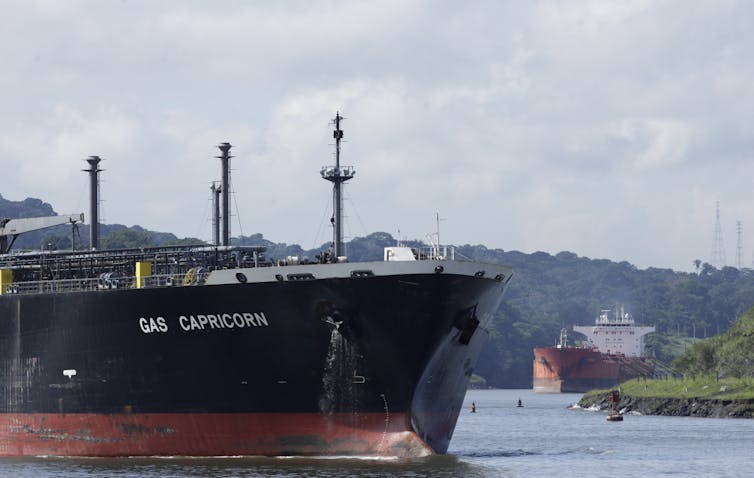
Cargo ships navigate through Panama Canal waters in Gamboa, Panama, in June 2020. (AP Photo/Arnulfo Franco)
A COVID-19 outbreak in an oil-producing country or on board a tanker could disrupt the flow of crude oil to the Saint John refinery and, consequentially, disrupt the flow of its refined products to most of Atlantic Canada and New England.
Irving Oil’s decision to find alternate ways to access Western Canadian crude oil from British Columbia via the Panama Canal or the U.S. Gulf Coast will undoubtedly increase the diversity of its supply. However, Irving’s concerns over COVID-19 and its international suppliers and shippers are equally applicable to Western Canada’s oilfields and any ships used to carry the crude oil.
To be fair, Irving has few other choices: crude-by-rail is a possibility, but there is limited capacity in its rail yard; TransCanada killed the Energy East project and even if it could be revived, it would take years to complete.
Several countries have already had key institutions undermined by the COVID-19 pandemic, or its political manipulation. As a result, civil and constitutional rights, like the freedoms of assembly and expression, have been diluted if not cancelled outright — all in the name of fighting the deadly virus. Those rights may or may not be restored.
Let’s run through a list of governments eroding democracy under cover of pandemic — and don’t be surprised to find Canada in there, edging towards membership.